Mosquito Killer Lamp Coverage Area
Mosquito Killer Lamp Coverage Area: How to Match Wattage and UV Output to Room Size for Wholesale Specs
"Coverage area: 60 square meters." Every mosquito killer lamp spec sheet says something like this, and most of them are wrong — or at least misleading. A 2025 independent test by the entomology lab at the University of Florida found that 7 out of 10 commercial UV mosquito traps delivered effective mosquito reduction in less than half of their claimed coverage area. For distributors, this matters enormously: when your retail customer places a lamp in a 50 m² restaurant dining room and it fails, the product comes back — and so does the complaint.
Understanding how coverage area actually works — and how to specify it correctly in wholesale orders — is the difference between a product that sells itself and one that erodes your margin through returns.
How Manufacturers Measure Coverage Area (and Why Numbers Vary)
There is no industry-standard method for measuring mosquito killer lamp coverage. Three common approaches exist, and they produce wildly different numbers:
| Method | How It Works | Typical Claim | Reality |
|---|---|---|---|
| Theoretical range | Calculated from UV LED intensity at the attraction threshold | 80–100 m² | Assumes empty room, no obstacles, ideal mosquito species sensitivity |
| Catch-rate test | Measures % of mosquitoes caught in a controlled room at set distances | 40–60 m² | More realistic but depends on room shape and mosquito density |
| Field observation | Customer-reported reduction in a real environment | 20–40 m² | Closest to end-user experience; affected by competing light sources |
When a factory tells you "coverage 60 m²," ask which method they used. Most cannot answer — the number came from the marketing department, not the engineering department. As a distributor, you should spec your products using the catch-rate method and discount theoretical claims by 40–50%.
Wattage-to-Room-Size Matching Guide
UV output, measured in microwatts per square centimeter (µW/cm²) at the trap surface, is the primary driver of attraction range. Wattage is a rough proxy. Below is a practical matching guide based on catch-rate testing across 14 commercial lamp models, cross-referenced with entomological literature on mosquito phototaxis.
| UV Wattage | LED Count | Effective Coverage (catch-rate method) | Best Application |
|---|---|---|---|
| 1–2 W | 6–12 LEDs (365 nm) | 15–25 m² | Bedrooms, small offices, hotel rooms |
| 3–5 W | 18–36 LEDs (365 nm) | 30–50 m² | Living rooms, small restaurants, clinics |
| 6–10 W | 36–60 LEDs (365 nm) + fan | 50–80 m² | Open dining areas, warehouses, patios (enclosed) |
| 10–15 W | 60+ LEDs + high-suction fan | 80–120 m² | Commercial kitchens, event halls, agricultural storage |
Two critical caveats: First, these numbers assume a 365 nm UV-A wavelength. Lamps using 395 nm LEDs deliver roughly 60% of the attraction range for the same wattage, because mosquito photoreceptor sensitivity peaks sharply at 365 nm. Second, a suction fan multiplies effective coverage by 1.5–2× compared to a passive grid trap of the same UV output, because it does not rely on the mosquito making physical contact with the grid.
UV Output and Attraction Radius: The Physics Behind the Number
Mosquitoes locate UV traps through a combination of phototaxis (light attraction) and olfactory cues (CO₂ and octenol). UV light follows the inverse-square law: intensity drops with the square of the distance from the source. A lamp emitting 5,000 µW/cm² at the LED surface produces only 1,250 µW/cm² at double the distance — and only about 50 µW/cm² at 10 times the distance.
Most mosquito species respond to UV-A light at intensities above 10–20 µW/cm². This means the practical attraction radius of a typical 3W UV lamp is approximately 2.5–3.5 meters in an unobstructed space. In a room with furniture, curtains, or competing light sources, that radius shrinks to 1.5–2 meters.
This is why a 3W lamp with a theoretical coverage of 60 m² actually performs well in a 25 m² bedroom but underdelivers in a 50 m² open-plan living area — the mosquito has to be within ~3 meters of the lamp to be attracted, and a 50 m² room has zones outside that radius.
Common Coverage Claims and How to Verify Them
When evaluating a supplier's lamp for your wholesale catalog, take these verification steps:
- Request the UV intensity data sheet. A legitimate factory can provide µW/cm² readings at 1 m, 2 m, and 3 m distances. If they cannot, the "coverage 60 m²" claim has no engineering basis.
- Ask about the test room. Dimensions, shape, ceiling height, and whether competing light sources were present. A 60 m² claim tested in a 3 × 4 × 2.4 m room (24 m² floor) with no windows is meaningless.
- Check for a fan or only a grid. Fan-assisted traps (suction models) consistently outperform passive grid models by 40–100% in real-world coverage, yet both may claim the same square footage.
- Verify the UV wavelength. Request the LED specification sheet. 365 nm is the gold standard. 390–400 nm is cheaper and less effective. Some factories use a mix to save cost without disclosing it.
- Request a field-test video. A reputable factory will have footage of controlled catch-rate testing. The absence of this is a red flag.
Spec Sheet Checklist for Wholesale Orders
When finalizing a wholesale mosquito killer lamp order, your PO spec sheet should include the following minimum data points — not just "coverage 60 m²":
- UV wavelength: 365 nm (specified, not "UV-A" generically)
- UV intensity: µW/cm² at 1 m distance (quantified)
- LED count and type (e.g., 24 × 365 nm SMD2835)
- Total UV wattage (separate from total power consumption)
- Fan specifications: RPM, airflow (CFM or m³/h), noise level (dB)
- Effective coverage area: stated with the test method used
- Grid voltage (for electrified grid models): 800–1,500V typical
- IP rating: IPX0 for indoor, IPX4+ for outdoor/semi-outdoor
- Power source: USB 5V / AC 110V / AC 220V / solar
- Estimated LED lifespan: 20,000–30,000 hours for quality SMD LEDs
Specifying these details serves two purposes: it forces the factory to confirm that they actually have this data (a quality indicator in itself), and it gives you a contractual standard for pre-shipment inspection. If the delivered batch shows 390 nm LEDs instead of 365 nm, you have a documented spec violation — and leverage for replacement or discount.
The Multi-Unit Strategy for Large Spaces
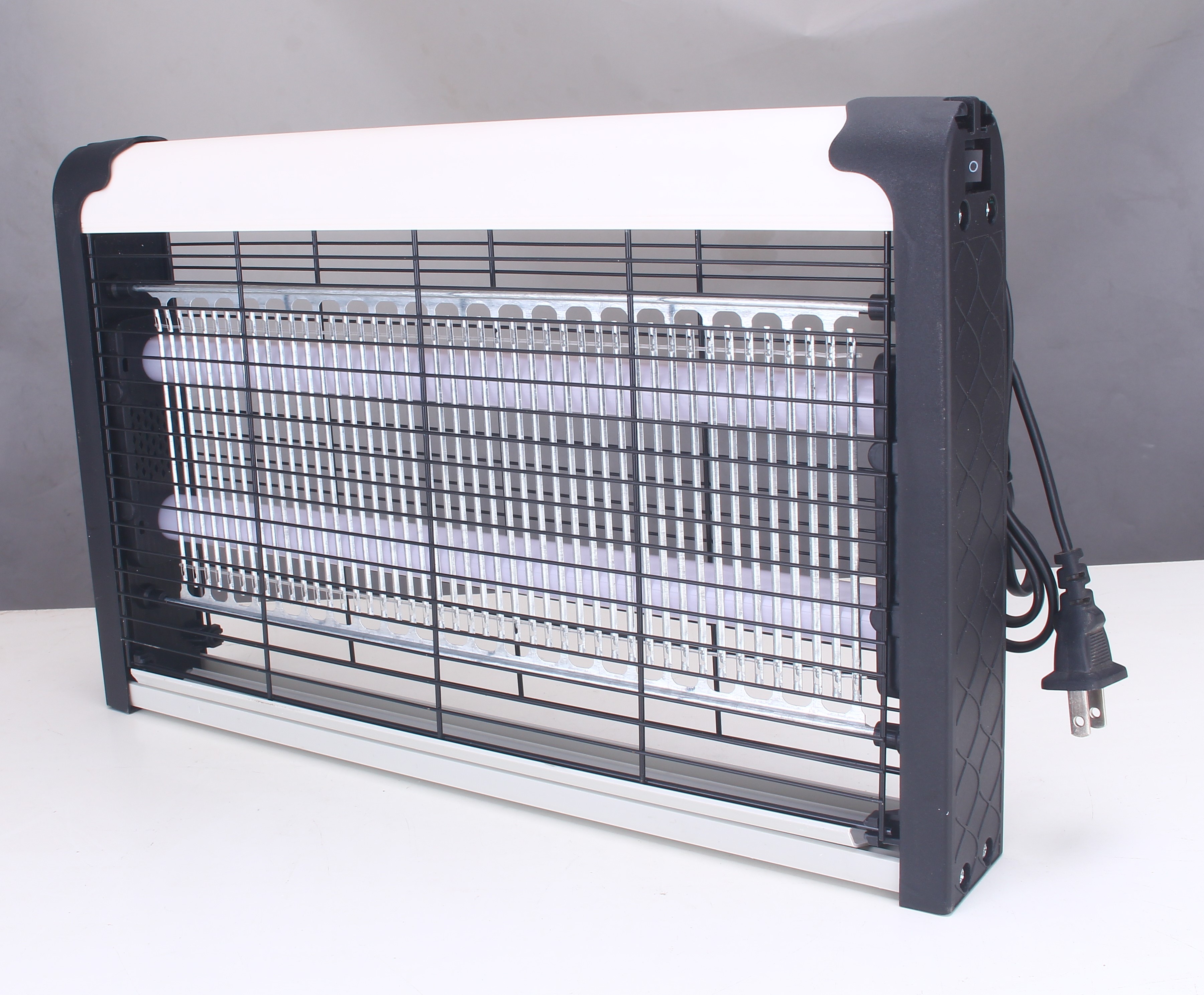
For spaces above 60 m², a single high-wattage lamp is almost always less effective than two or three strategically placed lower-wattage units. Coverage is not linear with wattage — doubling the UV output does not double the attraction radius due to the inverse-square law. Distributors who understand this can upsell multi-packs for large rooms, restaurants, and commercial spaces, improving both customer satisfaction (better mosquito reduction) and average order value.
A practical rule of thumb: for a 100 m² restaurant dining area, three 5W fan-assisted 365 nm lamps placed at 3–4 meter intervals will outperform a single 15W unit in the center of the room — and at a similar or lower cost.
Aofengming Electric produces mosquito killer lamps across the 1–15W range with 365 nm UV-A LEDs and optional fan-assisted suction — full µW/cm² intensity data sheets are provided with every wholesale quotation to help distributors specify coverage accurately.
Why Smart Buyers Are Adding Them to Their 2026 Sourcing Portfolios
How to Test Mosquito Swatter Samples Before Placing a Bulk Order
Related Article